
Private Hospital Strata Suites and the Cash Rate: Why Values Have Held
The cash rate has swung between 7.25% and 0.10% since 2008. Private hospital strata suite prices kept climbing. Here is why, and what could change it.
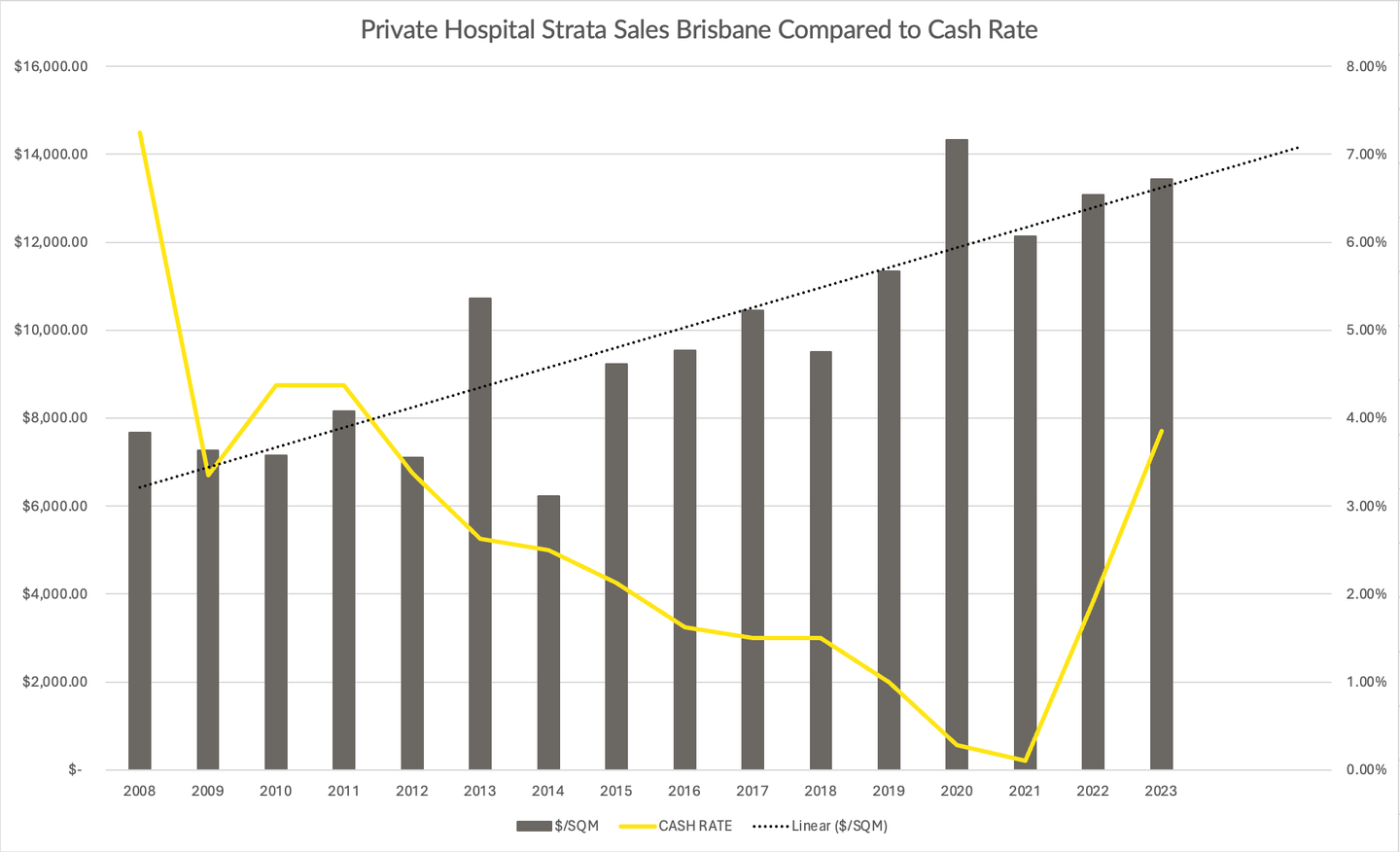
Private hospital strata suites held their value through every interest rate cycle between 2008 and 2023. RWC Medical's analysis of Pricefinder sales data for that period found the price per square metre of these suites kept a steady climb, with only minor fluctuations that did not follow the Reserve Bank of Australia (RBA) cash rate. Over the same years the cash rate fell from 7.25% to 0.10% and rose again to 4.35%. The reason is structural. Specialists need rooms beside the hospitals where they operate, and very few of those rooms exist.
Do private hospital strata suite prices follow the cash rate?
Not on the evidence of 2008 to 2023. The original RWC Medical chart plotted the price per square metre of private hospital strata suite sales against the cash rate. Prices climbed steadily, with minor fluctuations, and the linear trend line ran consistently upward. The cash rate, meanwhile, moved between 7.25% and 0.10%.
Most commercial property doesn't behave that way. When the cash rate rises, borrowing becomes less affordable and buyers in other sectors pull back. In hospital strata, demand did not wane significantly as rates rose, and prices were sustained or even increased in the final years of the analysis.
The chart below ends in 2023. The pattern is the point.
How has the RBA cash rate moved since 2008?
The RBA's cash rate target has turned sharply several times since the start of the period RWC Medical studied:
- 2008 to 2009: from 7.25% in March 2008 to 3.00% by April 2009, during the global financial crisis
- November 2010: back up to 4.75% after seven rises
- November 2020: down to 0.10%, the low point
- November 2023: 4.35% after 13 rises in 18 months
- August 2025: 3.60% after three cuts
- November 2026: 4.85% after five rises in 2026
The cash rate target stands at 4.85% as at 20 November 2026. That is higher than the 4.35% in place when this analysis was first published in March 2024, and the highest since late 2008.
The five rises of 2026 are a fresh test of the pattern. The price series has not yet been extended beyond 2023, so this guide makes no claim about what suites sold for between 2024 and 2026. Buyers and sellers should rely on current sales evidence for the specific building.
Why do specialist suites near private hospitals hold their value?
Demand is tied to the hospital, not the economy
Healthcare is an essential service, so demand for the real estate that houses it is less sensitive to interest rates. Medical professionals need strategically located, well-equipped rooms whatever the economic conditions.
Take Brisbane. A surgeon with theatre lists at Greenslopes Private, the Wesley in Auchenflower, St Andrew's War Memorial in Spring Hill, Mater Private in South Brisbane or North West Private in Everton Park wants consulting rooms a short walk from theatre and the ward. No rate decision changes that.
Patient demand sits behind it. At 30 June 2026, 12.8 million Australians, or 45.8% of the population, held hospital treatment cover, according to the Australian Prudential Regulation Authority (APRA). An ageing population adds to the load each year, a trend set out in the guide to healthcare infrastructure investment.
Supply is limited and slow to add
Developing private hospital strata takes significant capital and time, because healthcare buildings face stringent regulation and specific technical requirements. A hospital campus has a fixed number of titled suites, and the land around an established hospital is usually built out.
Construction costs make it harder still. CBRE's 2026 healthcare report says construction cost inflation and code upgrades have limited new speculative medical supply and kept vacancy low in quality stock.
New hospitals are not arriving quickly either. Dexus Research expects $1.8 billion of private hospitals to complete nationally between 2026 and 2028, well below the 10-year average, while demand for private hospital services rises.
Many buyers are owner-occupiers
Specialists often buy suites for their own practice. An owner-occupier is choosing a place to work, close to referrers, theatres and colleagues, and that decision turns on the practice more than on this year's borrowing costs. Limited supply and inelastic demand together explain why prices held, or rose, as the cash rate climbed.
What are the risks of buying a private hospital strata suite?
Stable is not the same as risk-free. Four issues deserve a hard look before contract:
- The hospital operator. A suite is worth most beside a busy, well-run hospital. Healthscope's receivers announced a plan in February 2026 to move 31 hospitals into a new not-for-profit operator, and M3 Property's Queensland Market Snapshot (April 2026) says the situation casts doubt over private hospital investment quality until it is resolved.
- Borrowing costs. Higher rates still reduce what a buyer can borrow, even where prices hold.
- Liquidity. Scarcity cuts both ways. Sales are infrequent, comparable evidence is thin and a sale can take longer than in a broader market.
- Title and building conditions. Body corporate levies, by-laws and any use restrictions linked to the hospital should be read before signing.
The same checks that apply to larger assets apply here. The guide to the top five medical property investment mistakes covers tenant strength, fit-out and lease security.
Should a specialist buy or lease consulting rooms near a hospital?
Owner-operation is where hospital strata is particularly appealing. A specialist who buys secures the location for the life of the practice and takes any capital growth that scarcity delivers. A specialist who leases keeps capital free and can move as a practice changes.
Neither is right for everyone. Those leaning towards leasing can start with RWC Medical's tenant advisory service. Those ready to buy, or owners considering a sale, can use the property sales service. For a Spring Hill example of medical suites, see Wickham Private.
One question is worth asking before any purchase: what did the last three sales in the building achieve per square metre, and how long did each take to sell?
An earlier version of this analysis, by Franz Stapelberg, was published by Commo in March 2024.
Prices in the original analysis were sourced from Pricefinder and cash rate information from the Reserve Bank of Australia (RBA). RWC Medical is not responsible for any inaccuracies or reliance on this information.
For landlords
Maximise yield on your medical asset.
Leasing, marketing and tenant placement for medical and commercial landlords across Queensland. A 10-minute call is usually enough to see if we can add value.